
Elise Chong - MetSO - Double Australian Premiere
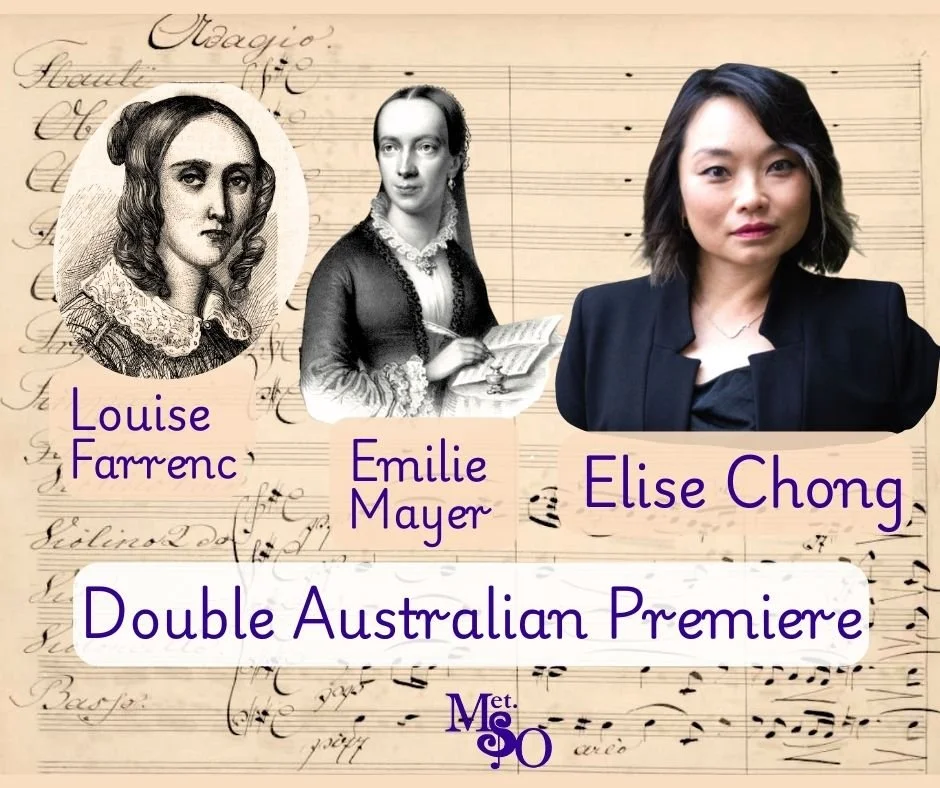
Elise Chong
Double Australian Premiere
with MetSO
”Timeless” - Nov 30th 2025
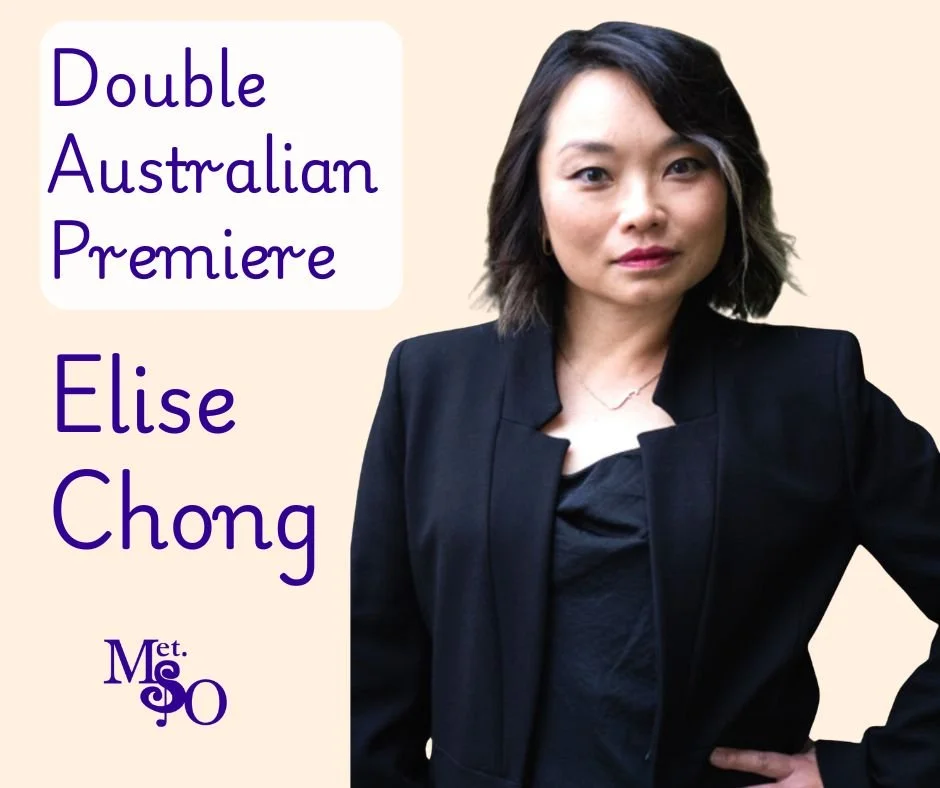
Elise Chong - Double Australian Premiere - MetSO “Timeless” Nov 30th 2025
From the MetSO Team -
N.B. Trubcher's first printed edition of Mayer Symphony No. 6 (made from Mayer's original score) had a “world premiere” in Neubrandenburg only in May 2012 at the 200th anniversary of Mayer's birth! And so it is indeed a rare gem. It is greatly significant therefore that MetSO is performing it for the first time in Australia in 2025.
In fact - after some additional AI and Google searching, this may be even more historically significant, because we are quite certain that we will be presenting this for the first time ever in the Southern Hemisphere!
This wonderful article by Conductor - Elise Chong also forms part of our extended program notes for MetSO’s Double Australian Premiere of these two important master works by Louise Farrenc and Emilie Mayer.
Article by
Elise Chong
on our extraordinary
Double Australian Premiere
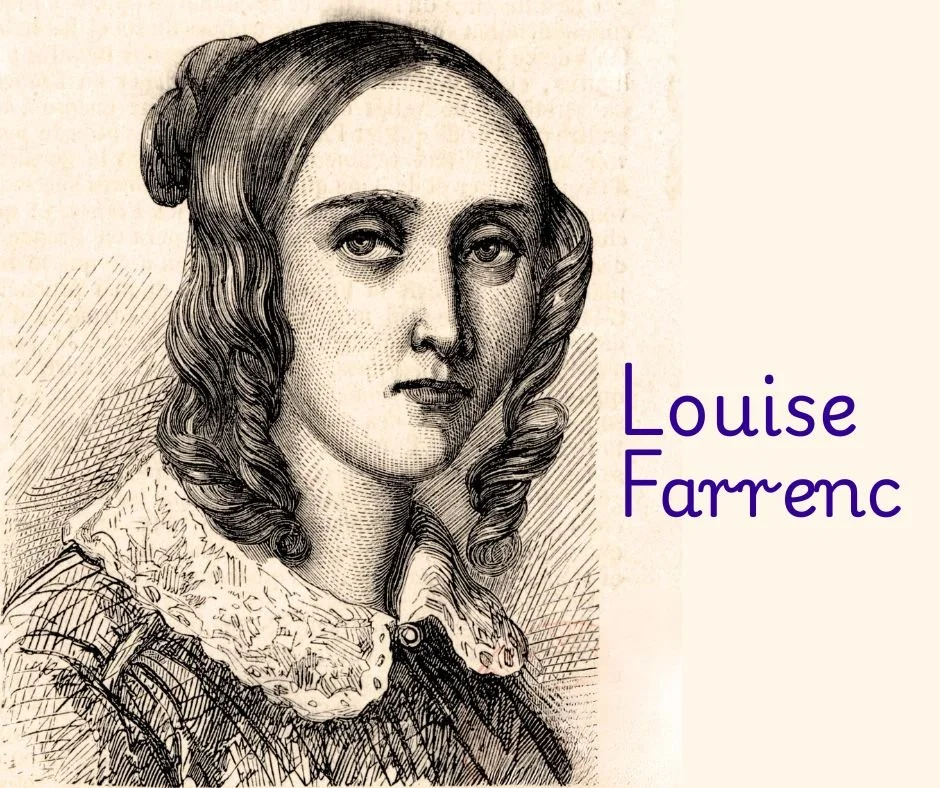
Louise Farrenc - MetSO’s Australian Premiere - Farrenc Overture no 1.
Louise Farrenc (1804–1875)
Australian Premiere
Overture No. 1
Louise Farrenc was one of the most accomplished and influential musical figures in 19th-century France, though her reputation was largely overshadowed in her own time by the dominant operatic culture of Paris. Born into a family of artists, Farrenc showed prodigious musical talent early and studied piano with some of the best teachers of the day. Being a woman, she was barred from officially studying composition at the Paris Conservatoire. However, when she was fifteen, her parents arranged for her to start taking private lessons with a Conservatoire teacher named Anton Reicha, a renowned theorist and composer. Reicha was a friend of Beethoven and would go on to teach Liszt and Berlioz. He became Farrenc’s primary pedagogical influence and her rigorous training in counterpoint, form, and orchestration shaped her lasting approach to composition.
Farrenc began her career as a touring pianist with her husband, flautist Aristide Farrenc, but her growing interest in composing led her toward larger-scale works. In 1842, after establishing herself as a formidable pedagogue, she was appointed Professor of Piano at the Paris Conservatory—a groundbreaking achievement, as she was the only woman to hold such a permanent position in the 19th century. She remained there for more than three decades, becoming one of the Conservatory’s most respected teachers. Her compositional output includes symphonies, overtures, chamber music, piano works, and educational studies. In an era when women composers were rarely taken seriously in orchestral genres, Farrenc’s symphonies and overtures were praised for their structural integrity, clarity of thought, and expressive power. Her chamber music was especially admired and frequently performed. Despite her accomplishments, she struggled for equal recognition: she famously fought for—and finally received—equal pay at the Conservatory after the triumph of her Nonet in E-flat major, Op. 38.
One of the most unjustly neglected composers of her generation, Farrenc’s music today is enjoying a deserved revival, revealing a composer of striking imagination, technical mastery, and emotional range—one who contributed significantly to 19th-century orchestral and chamber repertoire.
Overture No. 1 in E Minor, Op. 23 (1834) Adagio - Allegro agitato
Farrenc’s Overture No. 1 opens with a stately, regal, dotted figure introduction - typical of the French Overture style - then launches into a vigorous Allegro agitato propelled by driving rhythms and Beethovenian energy. Farrenc balances storminess with lyrical warmth, crafting an overture both concise and emotionally charged. Each melodic motif has a different character, reminiscent of an opera overture. It stands as an early testament to the expressive depth that characterises her finest orchestral writing.
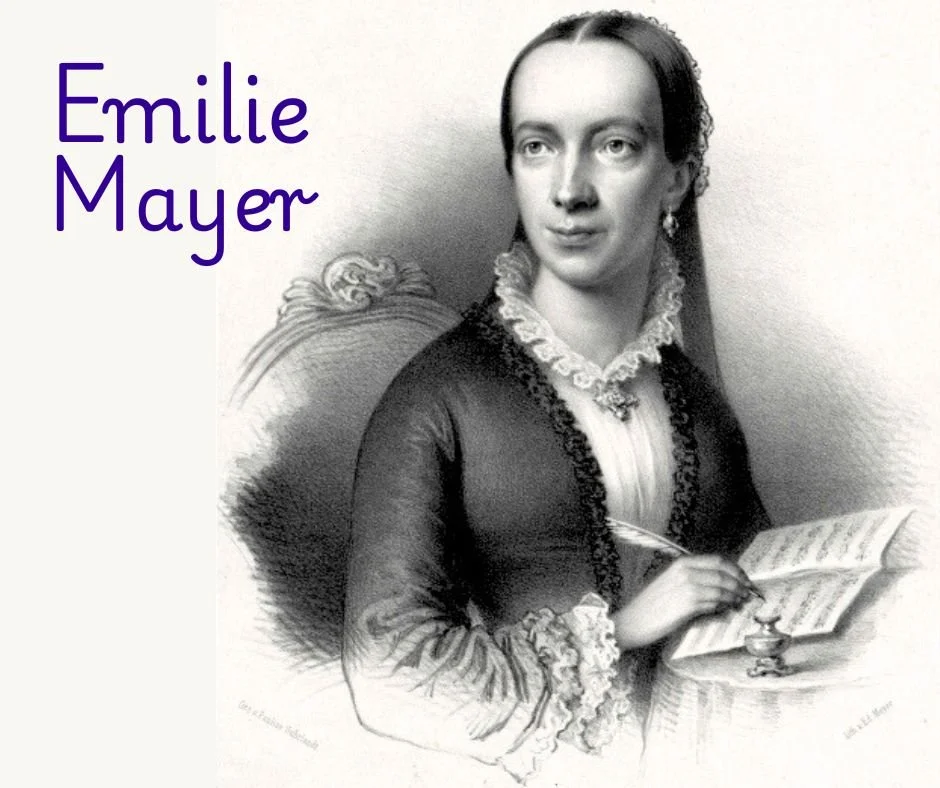
Emilie Mayer - MetSO’s Australian Premiere - Mayer Symphony no 6.
Emilie Mayer (1812–1883)
Australian Premiere
Symphony No. 6
Emilie Mayer was one of the most prolific and original German symphonists of the 19th century, yet her achievements were largely forgotten until recent decades. Born in Friedland in Northern Germany, Mayer began composing relatively late in life. The death of her father in 1840 prompted her to move to Stettin (now Szczecin, Poland), where she studied composition with the esteemed composer and conductor Carl Loewe. Loewe quickly recognised her talent, calling her “a remarkable phenomenon” and encouraging her to pursue composition seriously.
Mayer later moved to Berlin, where she continued advanced studies in counterpoint and orchestration with prominent teachers, immersing herself in the city’s vibrant musical culture. She became well-connected with musicians, patrons, and intellectuals, and her works were premiered by leading ensembles. Throughout the mid-19th century she gained considerable recognition, with frequent performances of her symphonies, overtures, chamber pieces, and choral works across Germany. Remarkably, she composed eight symphonies—an extraordinary number at a time when even major male composers often produced only a handful.
Her music blends Classical clarity with Romantic expressiveness, often marked by strong thematic development, bold harmonic choices, and imaginative handling of orchestral colour. Mayer’s works were praised by contemporary critics for their craftsmanship and emotional breadth, and she enjoyed a career of real distinction. After her death, however, her music—like that of many women composers—fell into obscurity.
The resurgence of interest in Mayer in the 21st century has revealed a composer of remarkable skill and originality. Her symphonies, in particular, show a masterful command of form and a compelling personal voice that enriches our understanding of the Romantic symphonic tradition Symphony No. 6 in E major (1853)
Emilie Mayer’s Symphony No. 6 stands among her most vibrant and confident orchestral works, displaying a composer in full command of symphonic form and expressive scope. Written during her productive Berlin years, the Sixth Symphony blends Classical poise with bold Romantic imagination—characteristics that made Mayer admired in her lifetime and increasingly appreciated today.
The edition we perform from today (November 30th 2025 , MetSO’s “Timeless”) was created by Roz Trübcher in 2012 from the original manuscript in Staatsbibliothek zu Berlin - Preussischer Kulturbesitz, Musikabteilung mit Mendelssohn - Archiv. You can view Mayer’s original manuscript digitally here:
From the conductor score notes by Roz Trübger in December 2011:
A triangle is included in the orchestra for the fourth movement of this symphony which has been dated by Mayer’s biographer Aleut Runge-Will to 1853, the same year in which Liszt included a triangle into his piano concerto in Eb.
There seems only ever to have been a single performance of this 6th symphony before the 20th Century, when it was performed in Neubrandenburg during celebrations marking the 200th anniversary of the composer’s birth.
I. Adagio - Allegro con Spirito
The symphony opens slowly in E minor; initially soft and lyrical, building in dynamic and tension to create a dramatic introduction and then turning tender and gentle at the end of the introduction. Mayer then writes a bright, assertive first theme propelled by rhythmic vigour in the violas and celli. Listen out for dramatic dynamic changes and beautiful lyrical themes throughout the movement. Rooted in Classical clarity, Mayer’s writing recalls the structural discipline of Beethoven and Mendelssohn, yet her voice is unmistakably her own. The orchestration is luminous, with woodwinds and brass often adding colouristic touches rather than overpowering the texture.
Throughout the movement, Mayer shows a gift for motivic development—fragments of the opening theme are transformed, exchanged between sections, and driven toward a jubilant, energetic coda.
II. Marcia Funebre (Andante maestoso)
The slow movement offers a dramatic contrast, unfolding with expansive lyricism and remarkable emotional depth. Here Mayer draws on a genre with rich musical history; Beethoven’s Marcia Funebre from his Symphony No. 3 Eroica (1802-1804) was the first orchestral work to expand and deepen a form that had already existed since in the 17th century. Chopin also drew from Beethoven’s inspiration, composing one of the most famous funeral marches in his Piano Sonata No. 2 Op. 35 (1839). Mayer’s Marcia Funebre follows the typical characteristics of the genre; a solemn march with a very slow tempo, a dotted rhythm and minor key. A triplet figure features throughout the whole movement, reminiscent of fate knocking on the door.
Listen out for the beautiful, expansive major chorale section that contrasts starkly from the melancholic character of this movement.
III. Scherzo
Mayer’s scherzo bristles with energy and good humour. Its rhythmic motives bounce playfully between orchestral sections, creating a sense of buoyant motion. The texture is light and nimble, reminiscent of Mendelssohn’s scherzos but with Mayer’s characteristic rhythmic punch and dynamic contrast. This movement highlights Mayer’s strong instinct for pacing and her command of orchestral character.
IV. Finale – Allegro
The finale brings the symphony to a brilliant close, driven by momentum and joyful energy. Mayer spins her thematic material with assurance, using sequences, rhythmic propulsion, and bright orchestral colours to build excitement. There is a sense of celebration throughout, with the brass adding triumphant accents and the strings carrying energetic, dance-like figures. Listen out for the triangle solo in the middle of this movement; it is soft and you will need to be attentive to catch it!
The movement’s soaring themes and exuberant climaxes give the symphony a radiant conclusion and lasting impression of vitality and optimism.